
Craftsmanship
Every surround is cast, finished and inspected by hand in our Glendale, California shop. Glass fiber reinforced concrete gives us the detail of carved limestone at a fraction of the weight.
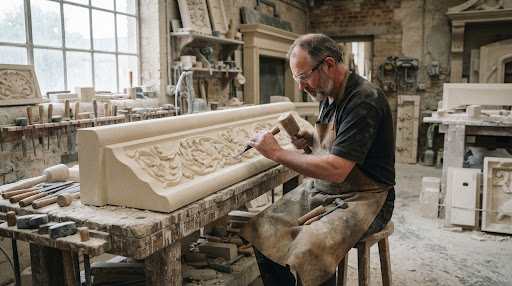
How a surround is made
Each design begins as a hand-sculpted master. From that master we build a rubber mould, then spray and pack GFRC in thin layers so the finished piece carries crisp profile detail without the mass of solid stone. Nothing is machine-stamped, and no two pieces are chemically identical — that variation is what makes it read as real stone.
-
Sculpt the master
Each profile is modelled by hand in clay and refined until the shadow lines read correctly.
-
Build the mould
A rubber mould is taken off the master and jacketed so it holds true through repeated casts.
-
Spray the face coat
A fine GFRC face coat picks up every detail of the mould surface.
-
Back and reinforce
Glass fibre layers are packed behind the face to build strength at low weight.
-
Cure and demould
Pieces cure under controlled conditions before the mould is opened.
-
Finish and inspect
Edges are dressed, colour is hand-applied, and every piece is checked before crating.
Why GFRC
Light enough to handle
Thin-wall GFRC weighs a fraction of solid cast stone, so two people can set a surround.
Fire resistant
The material withstands the heat of a large fire and suits masonry, gas and electric boxes.
Indoor and outdoor
It does not deteriorate when exposed to moisture, so the same piece works on a patio.
Crisp detail
Hand-sculpted masters keep the carved profiles sharp, run after run.